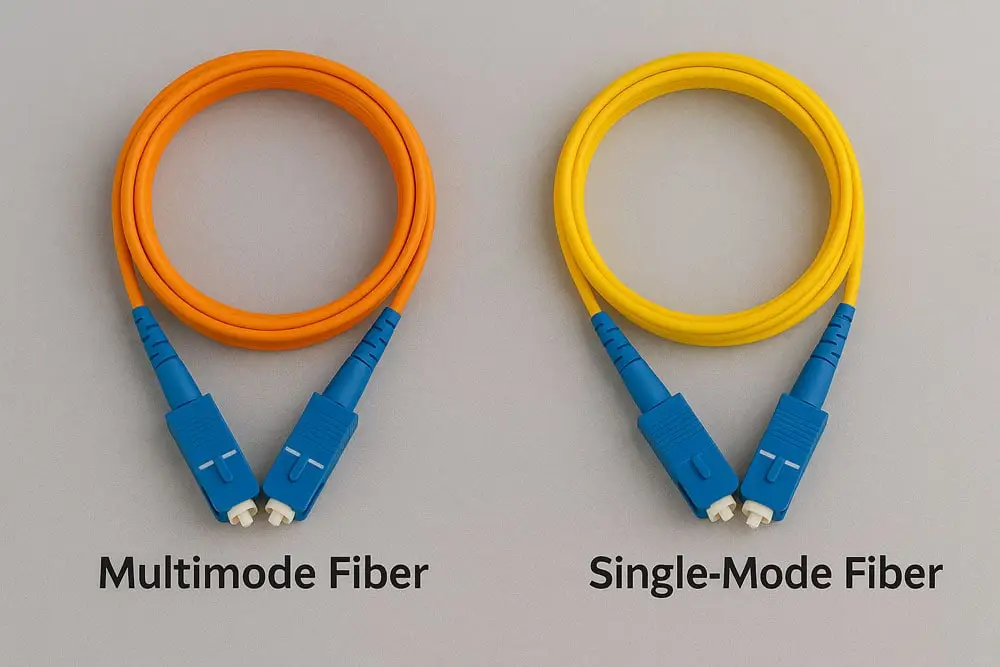
Single-Mode vs Multimode Fiber: Which One Should You Use?
Choosing between single-mode vs multimode fiber can feel confusing at first. However, the decision becomes simple once you understand how each cable works and where it performs best. In this guide, we break down the key differences so you can pick the right option for your network.
What Is Single-Mode Fiber?
Single-mode fiber has a very thin core, about 9 microns wide. Because of this, light travels in one direct path, which keeps the signal strong over long distances. As a result, single-mode cables can carry data for many kilometers with very little loss. Telecom providers, data center interconnects, and campus backbones rely on it for exactly this reason.
What Is Multimode Fiber?
Multimode fiber, on the other hand, has a larger core, usually 50 or 62.5 microns. This wider core lets multiple light paths travel at once. Consequently, the signal spreads out over distance, which limits how far it can go. Still, multimode works very well inside buildings and data centers, where cable runs are short.
Key Differences at a Glance
Distance. Single-mode supports runs of 10 km, 40 km, or even longer with the right optics. Multimode typically reaches 300 to 550 meters at 10 Gbps, depending on the grade (OM3, OM4, or OM5).
Cost. Interestingly, the cable itself is often cheaper for single-mode. Nevertheless, the transceivers are usually more expensive because they use precise lasers. Multimode optics, in contrast, use lower-cost VCSEL technology, so short-range setups often cost less overall.
Bandwidth. Both types handle high speeds today. Still, single-mode has a higher ceiling and is better prepared for future upgrades beyond 100G.
Installation. Single-mode needs tighter tolerances during splicing and connecting. Multimode is more forgiving, which makes it easier to deploy in many everyday projects.
When Should You Use Each One?
Choose single-mode fiber if:
- Your link is longer than 500 meters.
- You are connecting buildings or sites across a campus or city.
- You want a future-proof infrastructure that will not need replacing.
Choose multimode fiber if:
- Your runs stay within a building or a single data center.
- You are working with a tight budget on short links.
- Your equipment already uses multimode transceivers.
Can You Mix Them?
Generally, no. Single-mode and multimode cables are not interchangeable, because their cores and optics are different. Mixing them causes heavy signal loss. If you must connect both types, use media converters or compatible transceivers, and always check the specifications first.
Final Thoughts
In short, single-mode wins on distance and long-term scalability, while multimode wins on cost for short, high-speed links. Therefore, start by measuring your cable distances, then consider your budget and growth plans. With those three factors clear, the right choice usually becomes obvious
Pingback: Fiber Optic Connectors Compared: SC vs LC vs FC vs MPO - Globo Connected