Fiber Optic Connectors Compared: SC vs LC vs FC vs MPO
Picking a fiber connector may seem like a small detail. However, the wrong choice can waste rack space, raise costs, or hurt signal quality. In this guide, we compare SC vs LC vs FC vs MPO connectors so you can match each one to your network.
SC Connector: Simple and Reliable
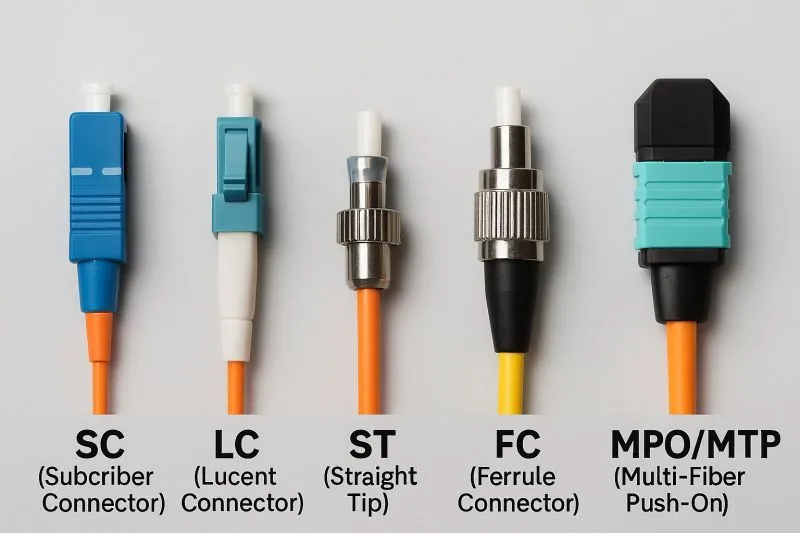
The SC (Subscriber Connector) has a square body and a push-pull design with a 2.5 mm ferrule. Because it clicks into place, it is easy to install without special tools. As a result, SC remains common in passive optical networks, CATV, and older enterprise cabling. Nevertheless, its larger size means fewer ports per panel.
LC Connector: The Data Center Favorite
The LC (Lucent Connector) uses a smaller 1.25 mm ferrule and a latch similar to an RJ45 plug. Therefore, it fits roughly twice as many ports as SC in the same space. In addition, most SFP and SFP+ transceivers use LC, which explains why it dominates modern data centers and enterprise networks.
FC Connector: Built for Stability
The FC (Ferrule Connector) features a threaded, screw-on coupling that holds the fiber firmly in place. Consequently, it resists vibration well and appears often in test equipment, laboratories, and industrial setups. On the other hand, screwing it on takes longer, so FC is rarely chosen for high-density installations.
MPO Connector: High-Density Multi-Fiber
MPO (Multi-fiber Push-On) connectors hold 8, 12, 16, or 24 fibers in a single rectangular ferrule. Thus, they support parallel optics for 40G, 100G, and 400G links. You may also see MTP, a high-performance MPO variant. Meanwhile, MPO requires careful polarity planning and regular cleaning, so good preparation matters.
Quick Comparison
| Connector | Fibers | Ferrule | Coupling | Best Use |
|---|---|---|---|---|
| SC | 1 | 2.5 mm | Push-pull | PON, CATV, legacy networks |
| LC | 1 | 1.25 mm | Latch | Data centers, enterprise |
| FC | 1 | 2.5 mm | Screw-on | Test gear, high-vibration sites |
| MPO | 8–24 | Rectangular | Push-pull with guide pins | 40G/100G/400G backbones |
How to Choose the Right Connector
First, check your equipment. If your transceivers and patch panels already use one type, staying consistent will save time and money. Second, consider density. Where space is tight, LC or MPO is usually the best option. Third, think about the environment. For vibration-heavy locations, FC offers a more secure fit. Finally, plan for growth. If you expect to move to 100G or higher, MPO trunk cabling can make future upgrades much easier.
In practice, many networks combine several types. For example, LC connectors often serve server-to-switch links, while MPO trunks connect switches across the data center. Likewise, hybrid patch cords (such as LC to SC) bridge older and newer equipment without a full replacement.
Final Thoughts
In short, LC is the best all-rounder, SC is a dependable legacy standard, FC is ideal for stability, and MPO leads in density and speed. Therefore, evaluate your space, your equipment, and your future bandwidth needs before you buy. With those factors in mind, the right connector becomes much easier to pick.