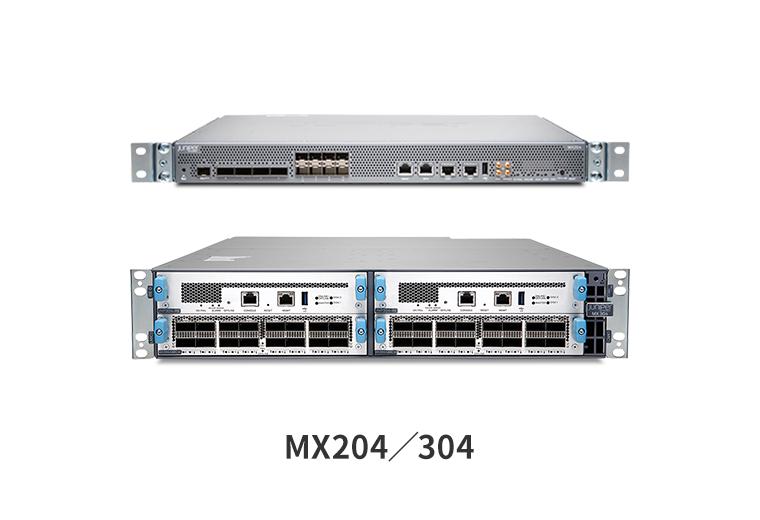
Enterprise Edge Routers: Juniper MX204 vs. MX304 for Modern Backbones
Juniper MX204 vs MX304: Choosing the right compact edge router for an Internet Service Provider (ISP) or enterprise Data Center backbone can drastically shape your long-term operational costs. Traditionally, high-density 100GbE routing required massive multi-slot chassis that consumed several rack units and drew excessive power.
However, modern network traffic demands have forced hardware manufacturers to condense full-scale routing capabilities into ultra-compact form factors. Within the Juniper Networks ecosystem, two fixed and semi-modular platforms stand out above the rest: the Juniper MX204 and the Juniper MX304.
In this guide, we will break down the structural differences, performance capabilities, and ideal deployment scenarios for both hardware platforms.
The Evolution of Compact Edge Routing
Historically, network engineers had to choose between compact 1RU routers with limited routing tables or oversized modular chassis to handle full BGP internet tables.
Indeed, the introduction of Juniper’s Trio chipset architecture changed everything. By delivering line-rate packet processing with microsecond latency in a small footprint, edge routing became vastly more efficient.
Consequently, both the MX204 and MX304 were engineered to handle demanding edge tasks, such as BGP peering, CGNAT, subscriber management (BNG), and MPLS label switching, without requiring an entire rack cabinet.
Juniper MX204: The Industry Workhorse
The Juniper MX204 is a fixed-configuration 1RU edge router that quickly became an industry standard for mid-sized ISPs, regional data centers, and enterprise WAN edges.
Key Highlights of the MX204:
- Fixed Throughput: Delivers up to 400 Gbps of full-duplex system throughput.
- Port Flexibility: Features 4x 100GbE (QSFP28) ports and up to 24x 10GbE (SFP+) ports natively via breakout capabilities.
- Ultra-Compact Footprint: Fits into a standard 1RU rack space with low power consumption (under 400W).
Furthermore, because it runs full Junos OS with identical feature parity to larger MX-series chassis, it provides full FIB/RIB scale for multiple internet feeds.
Juniper MX304: The Next-Generation Powerhouse
While the MX204 built a stellar reputation, growing bandwidth requirements created a need for modular expansion and 400GbE capability in a small chassis. Enter the Juniper MX304.
The MX304 is built on the newer Trio 6 chipset, offering massive scalability in a compact 2RU form factor.
Key Highlights of the MX304:
- Massive Scaling: Delivers up to 4.8 Tbps of system capacity, making it twelve times more powerful than the MX204.
- Modular Interface Cards (LMICs): Offers flexible port configurations, including native 400GbE (QSFP-DD), 100GbE, and 10GbE options.
- Hardware Redundancy: Features redundant Routing Engines (REs), control planes, and hot-swappable power supplies for high availability.
Technical Comparison: MX204 vs. MX304
To help you evaluate which hardware fits your immediate growth strategy, here is a detailed side-by-side comparison:
| Architectural Feature | Juniper MX204 | Juniper MX304 |
|---|---|---|
| Form Factor & Size | 1RU Fixed Chassis | 2RU Semi-Modular Chassis |
| Max System Throughput | Up to 400 Gbps | Up to 4.8 Tbps |
| ASIC Architecture | Trio 4 Chipset | Trio 6 Chipset |
| 400GbE Support | No (Max 100GbE QSFP28) | Yes (Native QSFP-DD) |
| Control Plane Redundancy | Single Integrated RE | Dual Routing Engine Support |
| Target Environment | Mid-Market ISPs, Metro Ethernet, Edge Peering | Tier-1/Tier-2 Backbones, 400G Core Data Centers |
Practical Deployment Scenarios
When to Choose the Juniper MX204:
- Space and Power Budget Constraints: If you are colocating equipment in third-party data centers where rack units and power draw are heavily billed, the 1RU MX204 offers the highest ROI.
- Standard 10G/100G Infrastructure: If your immediate network growth does not require transitioning to 400GbE interfaces within the next 3 to 5 years.
- Cost-Effective BGP Edge: Ideal for multihomed enterprises needing full routing tables from multiple upstream providers.
When to Upgrade to the Juniper MX304:
- Preparing for 400GbE Backhaul: As content delivery networks (CDNs) and transit providers shift toward 400G links, the MX304 provides native compatibility.
- Mission-Critical High Availability: Organizations requiring non-stop routing (NSR) and hitless control plane failover need the dual Routing Engine capability of the MX304.
- High-Density Subscriber Aggregation: If you are running dense CGNAT or BNG services that require significant processing power, the Trio 6 ASIC delivers superior performance.
Summary
In conclusion, both platforms represent peak engineering for edge networking hardware. If your infrastructure prioritizes low power consumption and reliable 100GbE connectivity, the Juniper MX204 remains an unbeatable workhorse. However, if your long-term roadmap requires 400GbE density, modular hardware redundancy, and multi-terabit capacity, investing in the Juniper MX304 ensures your backbone stays future-proof.
Pingback: BGP Basics With Examples: How Internet Routing Really Works - Globo Connected